Address
64/2357 Kaloor - Kadavanthara Road , Cochin - 682017 , Kerala.

Address
64/2357 Kaloor - Kadavanthara Road , Cochin - 682017 , Kerala.
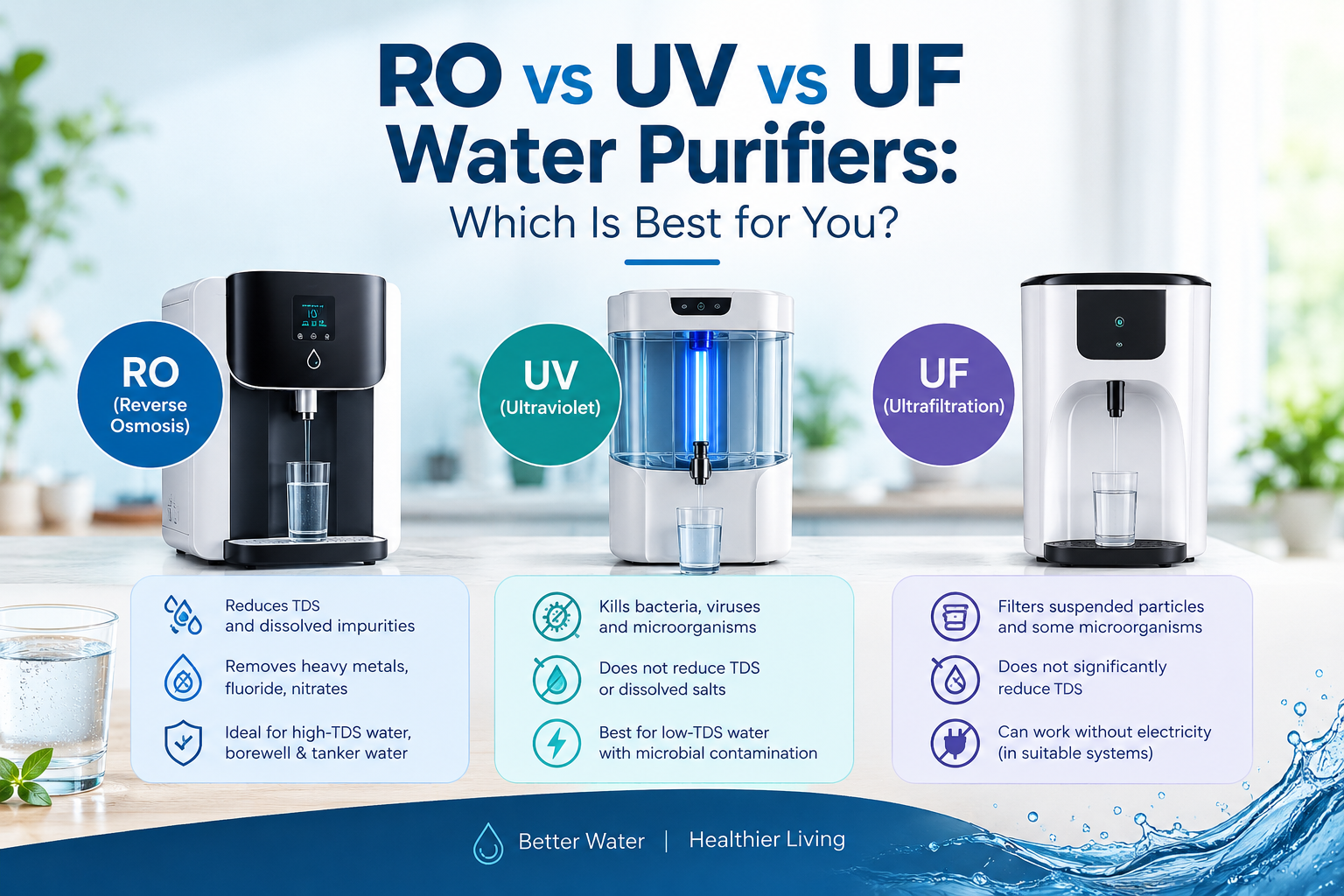
Choosing the right water purification technology can be confusing, especially when terms like RO, UV, UF, TDS, and water filtration appear everywhere. While all three technologies are designed to improve water quality, they work in very different ways. Understanding the difference can help you choose a solution based on your water source, contamination level, and household requirements.
In this guide, we explain RO vs UV vs UF Water Purifiers, how each technology works, what each one removes, and which option may be suitable for different types of water.
Before comparing the technologies, it is important to understand what each one does.
Reverse Osmosis (RO) uses a semi-permeable membrane to separate dissolved substances from water. Water is pushed through the membrane under pressure, helping reduce dissolved salts, certain heavy metals, fluoride, nitrates, and other dissolved impurities.
RO purification is particularly useful when water has high Total Dissolved Solids (TDS), high mineral content, or certain chemical contaminants. It is commonly considered for borewell water, tanker water, and other sources where dissolved impurities may be a concern.
However, RO systems generally require electricity and can produce reject water during the purification process.
UV water purification uses ultraviolet light to deactivate microorganisms such as bacteria and viruses. Unlike RO, UV does not remove dissolved salts or reduce TDS.
This makes UV technology more suitable when the primary concern is microbial contamination in relatively clear, low-TDS water. UV systems also require electricity because the purification process depends on a UV lamp.
Ultrafiltration (UF) uses a membrane to physically filter suspended particles and certain microorganisms. Unlike RO, UF does not significantly reduce dissolved salts or TDS.
One advantage of UF is that it can operate without electricity in suitable systems. It can therefore be useful where the water has low TDS but contains suspended particles or microbial contaminants.
The main difference between these technologies is the type of impurities they target.
| Feature | RO | UV | UF |
|---|---|---|---|
| Full form | Reverse Osmosis | Ultraviolet | Ultrafiltration |
| Reduces TDS | Yes | No | No |
| Targets dissolved salts | Yes | No | No |
| Controls microorganisms | Yes | Yes | Physically filters some |
| Removes suspended particles | With pre-filtration | No | Yes |
| Electricity | Generally required | Required | Not always required |
| Water wastage | Can produce reject water | No | No |
| Suitable for high-TDS water | Yes | No | No |
| Main strength | Dissolved impurities | Microbial disinfection | Physical filtration |
Therefore, when comparing RO vs UV vs UF Water Purifiers, there is no universal winner. The best option depends on the actual quality of the water entering your home.
TDS, or Total Dissolved Solids, represents the concentration of dissolved substances in water. High-TDS water may contain elevated levels of dissolved salts and minerals, depending on its source. Understanding TDS is especially important when comparing RO vs UV vs UF Water Purifiers, as each technology handles dissolved impurities differently.
If testing shows that your water has high TDS or specific dissolved contaminants, RO technology may be more appropriate than UV or UF alone. UV and UF do not provide the same dissolved-solids reduction as RO.
This is why water testing should come before choosing a water purification system. Instead of selecting a purifier simply because it has more features, identify the actual water-quality problem first and choose the purification technology that best matches your water conditions.
Municipal water quality can vary considerably between locations and even across seasons. When comparing RO vs UV vs UF Water Purifiers, it is important to consider the quality of your municipal water before choosing a purification technology. If the supplied water has relatively low TDS but microbial contamination is a concern, UV can provide an additional disinfection barrier.
UF may also be considered when suspended particles and certain microorganisms are concerns and dissolved solids are not the primary issue.
However, if municipal water has elevated TDS or dissolved contaminants, an RO-based solution may be more appropriate. Pre-filtration is also important because sediment and turbidity can affect the performance of downstream purification stages.
Borewell water can contain higher concentrations of dissolved minerals depending on local geology. Hard water is generally associated with minerals such as calcium and magnesium, which can contribute to scale formation in plumbing fixtures, heaters, washing machines, and other appliances. When comparing RO vs UV vs UF Water Purifiers, understanding the mineral content of borewell water is essential for choosing the right treatment approach.
For drinking-water purification, RO may be considered when testing identifies high TDS or dissolved contaminants. But it is important to understand that a drinking-water purifier and a whole-house water-conditioning system serve different purposes.
For household scale and hard-water management, KalyxX India provides specialized water treatment and conditioning products designed to help address scale-related problems without chemicals or electrical connections. Explore the KalyxX India product range to learn more about its solutions.
Yes. Many modern purification systems combine multiple technologies because each addresses a different type of water-quality concern.
An RO + UV system, for example, can combine dissolved-contaminant reduction with UV-based microbial disinfection. UF can also be incorporated as an additional filtration stage in some systems.
The important point is that adding more technologies does not automatically make a system better. The combination should be selected according to the water source, TDS, contamination profile, and treatment requirements.
KalyxX India focuses on innovative water treatment, water conditioning, and scale-management solutions rather than positioning its products as a replacement for every drinking-water purification technology.
Its product portfolio includes solutions such as KalyxX Active, BlueLine, RedLine, GreenLine, KalyxX Mini, and KalyxX Industry. These products are designed around water conditioning and scale-management applications.
KalyxX India is a leading water treatment brand in India, offering innovative solutions for water conditioning and scale management. The brand is also the exclusive distributor of Swiss Aqua Technologies in India, bringing advanced water treatment solutions based on patented IPS technology to the Indian market. You can learn more about the company through its About KalyxX India.
For readers interested in the technology behind these water-treatment solutions, you can also explore Swiss Aqua Technologies .
When choosing between these technologies, consider these factors:
Choose RO when:
Your water has high TDS or dissolved contaminants that require membrane-based reduction.
Consider UV when:
Your main concern is microbial contamination in relatively clear, low-TDS water.
Consider UF when:
You need physical filtration of suspended particles and certain microorganisms, particularly where electricity availability is limited.
Consider combination systems when:
Your water has multiple types of contamination that require more than one treatment method.
Most importantly, test your water before making a decision. Water source, TDS, hardness, turbidity, and microbial quality can all influence the right treatment approach.
Understanding RO vs UV vs UF Water Purifiers makes it easier to avoid choosing a system based solely on advertising or price. RO is designed to address dissolved impurities and high-TDS water, UV focuses on microbial disinfection, and UF provides physical filtration without significantly reducing dissolved salts.
The right technology depends on your water quality rather than a one-size-fits-all formula. Test your water, identify the actual problem, and then select a purification or water-conditioning solution that matches your requirements.
For homeowners also dealing with hard water and scale formation, combining appropriate drinking-water purification with a dedicated water-conditioning solution can provide a more complete approach to household water management.

Rinu Ann George is an SEO Analyst at Upgraderz,Specializing in Search Engine Optimization,Content Strategy and Digital Visibility.
