Address
64/2357 Kaloor - Kadavanthara Road , Cochin - 682017 , Kerala.

Address
64/2357 Kaloor - Kadavanthara Road , Cochin - 682017 , Kerala.
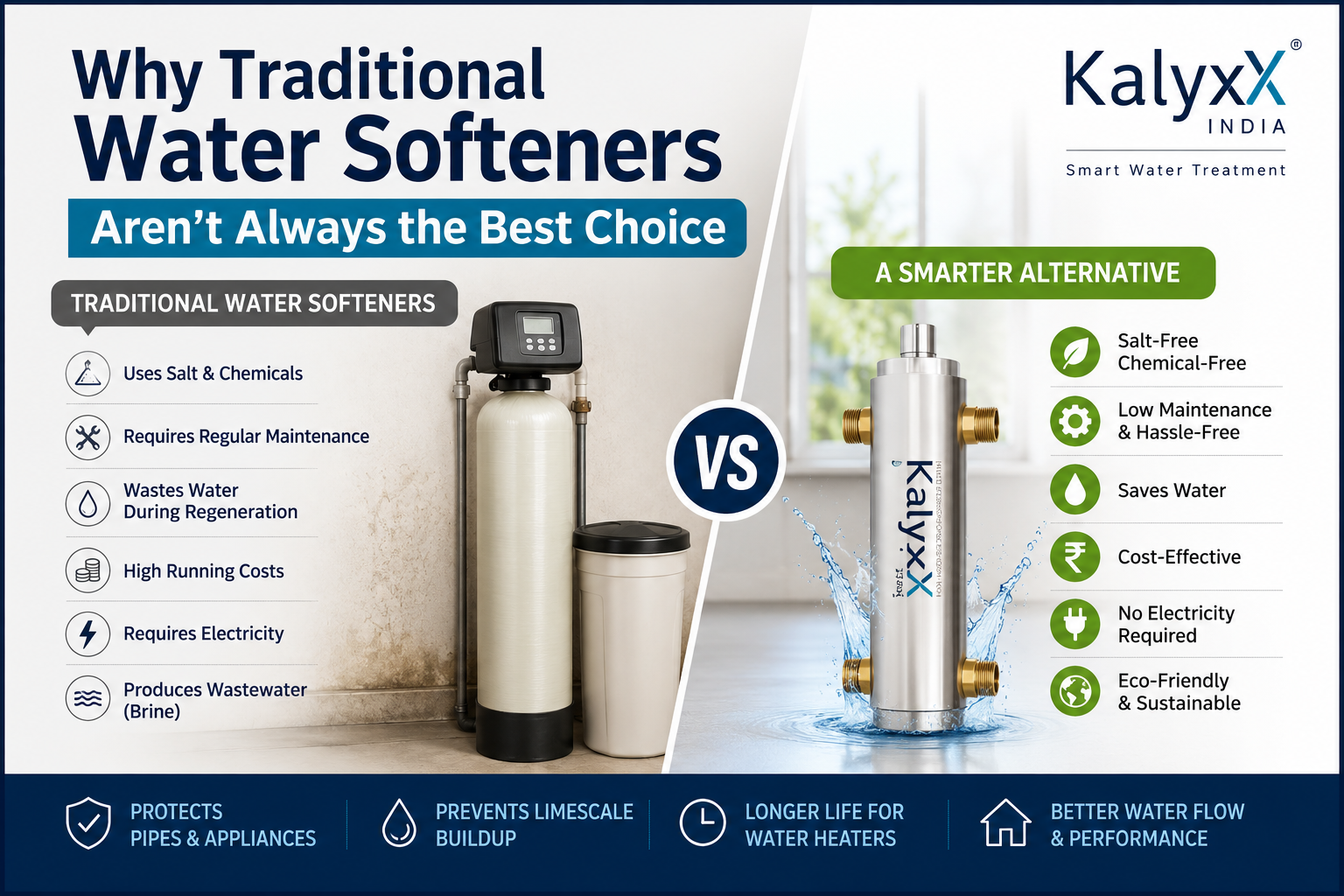
Hard water is a common household and commercial water-quality problem. High concentrations of minerals such as calcium and magnesium can contribute to limescale deposits on faucets, showerheads, pipes, water heaters, washing machines, and other appliances. For decades, homeowners have relied on Traditional Water Softeners to address these issues. However, conventional softening systems are not always the most practical or sustainable choice for every application.
Modern water treatment technology now offers alternatives that focus on scale prevention, lower maintenance, and environmentally responsible operation. Understanding how conventional systems work and where their limitations lie can help homeowners and businesses make a more informed decision.
Traditional Water Softeners generally use an ion-exchange process to reduce water hardness. In a typical salt-based system, water passes through resin beads that exchange calcium and magnesium ions for sodium ions. The resin eventually becomes saturated and must be regenerated using a salt solution.
This method can be effective for reducing hardness, but it also introduces ongoing requirements such as salt replenishment, regeneration cycles, water consumption, and routine maintenance. Depending on the household’s water quality and usage, these requirements may become inconvenient over time.
One of the biggest disadvantages of Traditional Water Softeners is maintenance. Salt-based systems require regular monitoring and replenishment of salt. The resin tank and associated components may also require periodic servicing to maintain proper performance.
Another consideration is water consumption. During regeneration, conventional systems use additional water to clean and recharge the resin. For households looking for more water-efficient solutions, this can be an important factor.
There is also the issue of brine discharge. Salt-based regeneration produces wastewater containing concentrated salts and minerals. Managing this discharge can raise environmental concerns, particularly where water conservation and responsible wastewater management are priorities.
Many conventional water treatment systems depend on salt or other consumable materials. Over time, the cost of purchasing salt, maintaining equipment, replacing components, and using additional water can add to the total cost of ownership.
While the initial purchase price is only one part of a water treatment investment, homeowners should consider the long-term operating expenses as well. Traditional Water Softeners may therefore be less attractive to users who want a low-maintenance water treatment system with fewer recurring consumables.
For this reason, chemical-free water treatment and salt-free scale prevention technologies have gained attention among homeowners and businesses looking for alternative approaches.
It is important to understand that water softening and scale prevention are not necessarily the same thing.
A conventional softener is primarily designed to reduce the concentration of hardness minerals in water. A scale prevention system, on the other hand, may aim to change how minerals behave so that they are less likely to form hard, adherent deposits on surfaces.
This distinction matters because not every application requires complete removal of calcium and magnesium. In many situations, the primary concern is protecting plumbing, water heaters, showers, faucets, and appliances from limescale buildup.
Modern water conditioning technologies can therefore provide another approach to managing hard water without relying on the conventional ion-exchange process.
Traditional Water Softeners can still be suitable in situations where reducing water hardness itself is the primary objective and the household is comfortable with salt, regeneration, maintenance, and associated operating requirements.
However, they may not be ideal for homeowners who prioritize:
The right solution ultimately depends on the property’s water quality, hardness level, flow rate, intended application, and treatment objective.
Advances in water treatment have introduced technologies designed to tackle limescale without the conventional salt-based softening process. One example is the Ion Polarization System (IPS), which is used in KalyxX water treatment devices.
According to product information from KalyxX India and Swiss Aqua Technologies, IPS technology is designed to alter the behavior and structure of minerals associated with limescale, helping reduce scale formation without adding salt or requiring electricity. KalyxX India lists several products for residential, commercial, and industrial applications.
For homeowners exploring alternatives, you can learn more about available models through the KalyxX India product range, which includes KalyxX Active, BlueLine, RedLine, GreenLine, KalyxX Mini, and Industry solutions. Explore KalyxX India Water Treatment Products
One important advantage of modern conditioning technologies is the potential to reduce dependence on salt and chemicals. KalyxX India describes its IPS-based solutions as chemical-free and designed to operate without an electrical connection.
For households, this can mean fewer consumables and less routine intervention. For commercial properties, reducing maintenance requirements can also help simplify water-system management.
Swiss Aqua Technologies, the technology developer associated with KalyxX, describes its approach as a sustainable solution for limescale protection and water improvement. Its KalyxX technology uses a patented Ion Polarization System designed to help prevent limescale and corrosion without chemicals or electricity.
You can also explore the technology and product ecosystem through Swiss Aqua Technologies, which provides additional information about KalyxX and its water-treatment technologies. Swiss Aqua Technologies
One of the major reasons people install Traditional Water Softeners is to protect appliances from mineral buildup. Hard water can contribute to deposits inside water heaters, washing machines, dishwashers, shower systems, faucets, and other equipment.
Scale buildup can interfere with heat transfer and water flow, potentially increasing maintenance requirements over time. A suitable scale-control solution can therefore be an important part of a broader appliance-protection strategy.
However, treatment should be selected according to the actual water problem. A scale-control device is not a substitute for filtration or disinfection when the concern involves sediment, microorganisms, heavy metals, or other contaminants.
When comparing Traditional Water Softeners with modern water conditioning systems, there is no universal winner. Conventional softeners can be appropriate when substantial hardness reduction is required. Modern scale-prevention technologies may be more attractive when the primary objective is controlling limescale while avoiding salt, regeneration cycles, and electrical requirements.
The most important step is to identify what you actually need from your water treatment system rather than selecting a solution based only on the word “softener.”
Before choosing Traditional Water Softeners or an alternative, consider the following:
Traditional Water Softeners have an established role in hard-water management, but they are not automatically the best solution for every property. Their dependence on salt, regeneration, maintenance, and additional water can make them less convenient for users seeking simpler and more sustainable water treatment.
Modern scale-control technologies provide another option, particularly when the main concern is limescale protection rather than complete removal of hardness minerals. By understanding the difference between softening, filtration, conditioning, and scale prevention, homeowners and businesses can choose a system that better matches their actual water-treatment requirements.
Ultimately, the best water treatment approach depends on water quality, application, maintenance expectations, budget, and environmental priorities. Instead of assuming that Traditional Water Softeners are the only answer to hard water, it is worth evaluating newer technologies and selecting a solution based on measurable needs and long-term performance.

Rinu Ann George is an SEO Analyst at Upgraderz,Specializing in Search Engine Optimization,Content Strategy and Digital Visibility.
