Address
64/2357 Kaloor - Kadavanthara Road , Cochin - 682017 , Kerala.

Address
64/2357 Kaloor - Kadavanthara Road , Cochin - 682017 , Kerala.
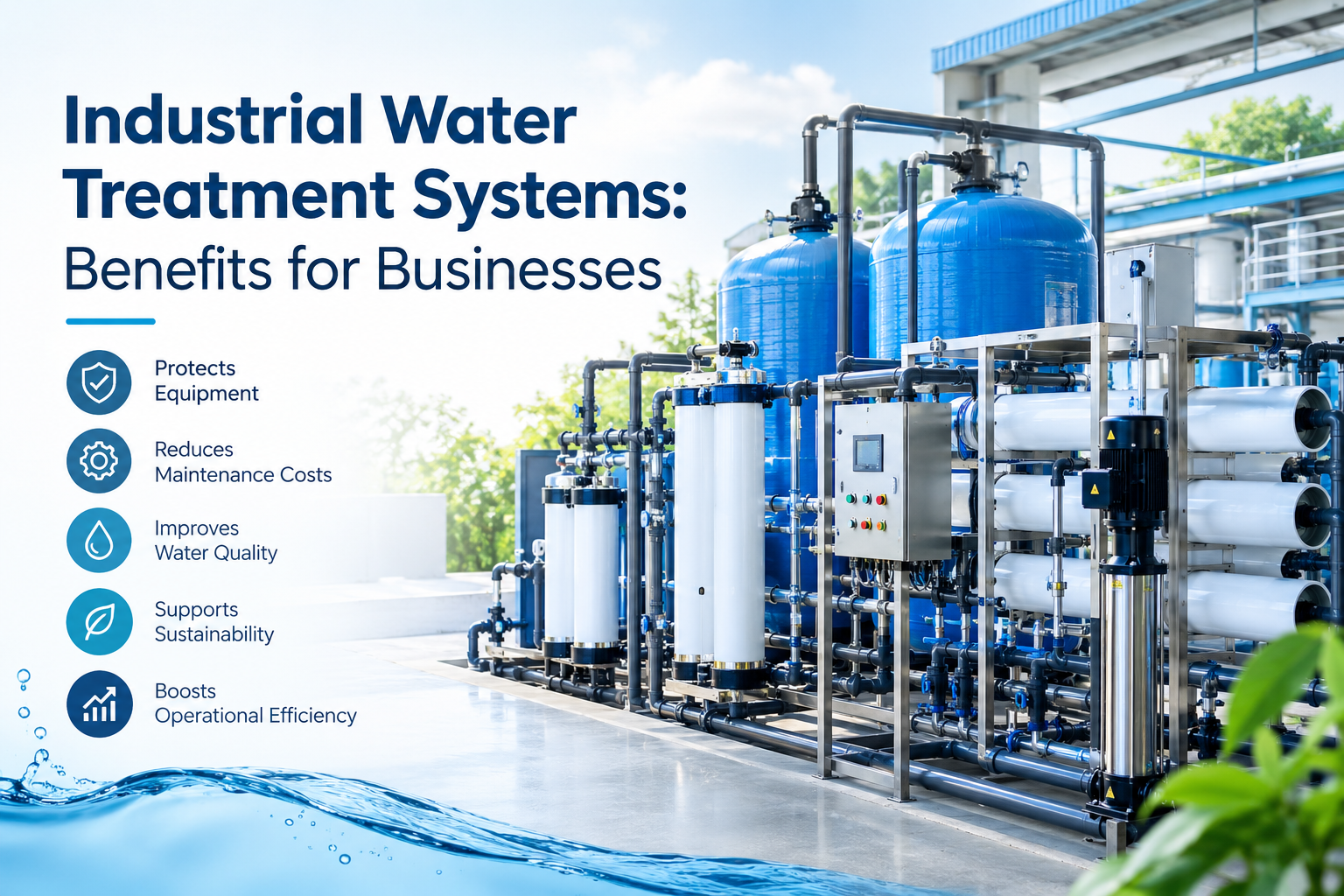
Water is an essential resource for manufacturing, food processing, pharmaceuticals, hospitality, power generation, textiles, and many other industries. From production and cleaning to cooling and boilers, consistent water quality directly affects day-to-day operations. Poor-quality water can lead to scaling, corrosion, equipment damage, higher maintenance costs, and process interruptions. This is why Industrial Water Treatment Systems have become an important part of modern business infrastructure.
Industrial Water Treatment Systems are solutions designed to improve water quality according to the requirements of a specific industrial process. Depending on the source water and intended application, treatment may involve filtration, water softening, reverse osmosis, disinfection, demineralization, or other technologies.
Unlike a one-size-fits-all approach, an effective industrial water treatment plant is designed around factors such as water chemistry, flow rate, contaminants, process requirements, and discharge or reuse needs. This helps businesses obtain water that is fit for purpose while controlling operating costs.
Hardness, suspended solids, dissolved minerals, and other contaminants can create scale, corrosion, and fouling inside pipes, heat exchangers, boilers, cooling systems, and production equipment. Industrial Water Treatment Systems help control these problems and can extend equipment life.
Cleaner water can also improve heat transfer and reduce the buildup that makes equipment work harder. As a result, businesses may experience fewer breakdowns and more predictable maintenance schedules.
Equipment affected by scale or corrosion generally requires more frequent cleaning, servicing, and replacement. Treating water before it enters critical processes can reduce these issues and help companies manage maintenance expenses more effectively.
For example, boiler water treatment can help control deposits and corrosion, while cooling water treatment can support efficient heat exchange. The treatment process should be selected according to the water quality and equipment requirements.
Water is often part of the manufacturing process, not simply a utility. In industries such as food and beverage, pharmaceuticals, chemicals, electronics, and textiles, inconsistent water quality can affect production results.
Industrial Water Treatment Systems provide controlled water quality for specific applications. Filtration and water purification systems can remove unwanted particles, while reverse osmosis and other advanced processes can reduce dissolved contaminants when a higher level of purification is required.
Freshwater availability and rising water costs are encouraging businesses to look beyond a single-use water model. Industrial wastewater treatment can make it possible to recover and reuse treated water for suitable applications such as cooling, cleaning, landscaping, or other non-potable operations.
These treatment solutions can therefore become part of a broader water recycling strategy. Reusing treated water can reduce freshwater demand, wastewater volumes, and dependence on external water sources. The appropriate reuse level should always be determined by the required water quality for the intended application.
Unexpected water-quality problems can interrupt production. Contaminated water may affect machinery, product quality, cleaning processes, and utility systems. A properly designed treatment setup provides a more consistent water supply and helps businesses reduce operational uncertainty.
Treatment solutions can also be integrated with monitoring and control processes so that important water-quality parameters can be tracked. This supports faster identification of problems and better operational decision-making.
Businesses need to manage wastewater responsibly and meet applicable environmental requirements. An effluent treatment plant can help treat wastewater before discharge or further reuse, depending on the characteristics of the wastewater and local requirements.
Better wastewater management also supports sustainable water management. Reducing unnecessary freshwater consumption and improving reuse can lower the overall environmental impact of industrial operations.
Water quality can influence the performance of boilers, cooling systems, heat exchangers, and other utilities. Scale and fouling can reduce heat-transfer efficiency and increase the energy required to achieve the same result.
By controlling water quality, Industrial Water Treatment Systems can help maintain equipment performance and support more efficient use of energy. This benefit is particularly relevant for facilities with continuous heating, cooling, or steam-generation requirements.
The right combination of technologies depends on the application. Common options include:
A modern industrial water treatment plant may combine several stages rather than relying on one technology. This approach allows treatment to be matched more closely to the quality of incoming water and the needs of the final process.
Before investing in a treatment solution, businesses should evaluate the source of water, laboratory water analysis, daily consumption, peak flow, process requirements, existing equipment, wastewater characteristics, available space, and future expansion plans.
The objective should be to achieve the right water quality for the intended use while keeping lifecycle costs, maintenance, energy consumption, and water recovery in mind.
Businesses can also review specialized solutions that complement their water-management strategy. Explore the KalyxX product range to understand the available water-treatment options for different applications.
Water treatment is no longer only a utility function. For many businesses, it is directly connected to equipment reliability, production quality, operating costs, environmental performance, and long-term resilience.
Industrial Water Treatment Systems can help companies protect critical assets, improve process consistency, reduce water consumption, and create opportunities for recycling and reuse. When treatment is designed around actual operating requirements, businesses can achieve a practical balance between water quality, efficiency, cost control, and sustainability.
As industries move toward smarter resource management, combining treatment, monitoring, wastewater management, and water reuse can create a more resilient approach to industrial water use. For businesses looking to adopt proven water-treatment technologies, learning more about Swiss Aqua Technologies can provide additional insight into modern approaches to water management.

Rinu Ann George is an SEO Analyst at Upgraderz,Specializing in Search Engine Optimization,Content Strategy and Digital Visibility.
