Address
64/2357 Kaloor - Kadavanthara Road , Cochin - 682017 , Kerala.

Address
64/2357 Kaloor - Kadavanthara Road , Cochin - 682017 , Kerala.
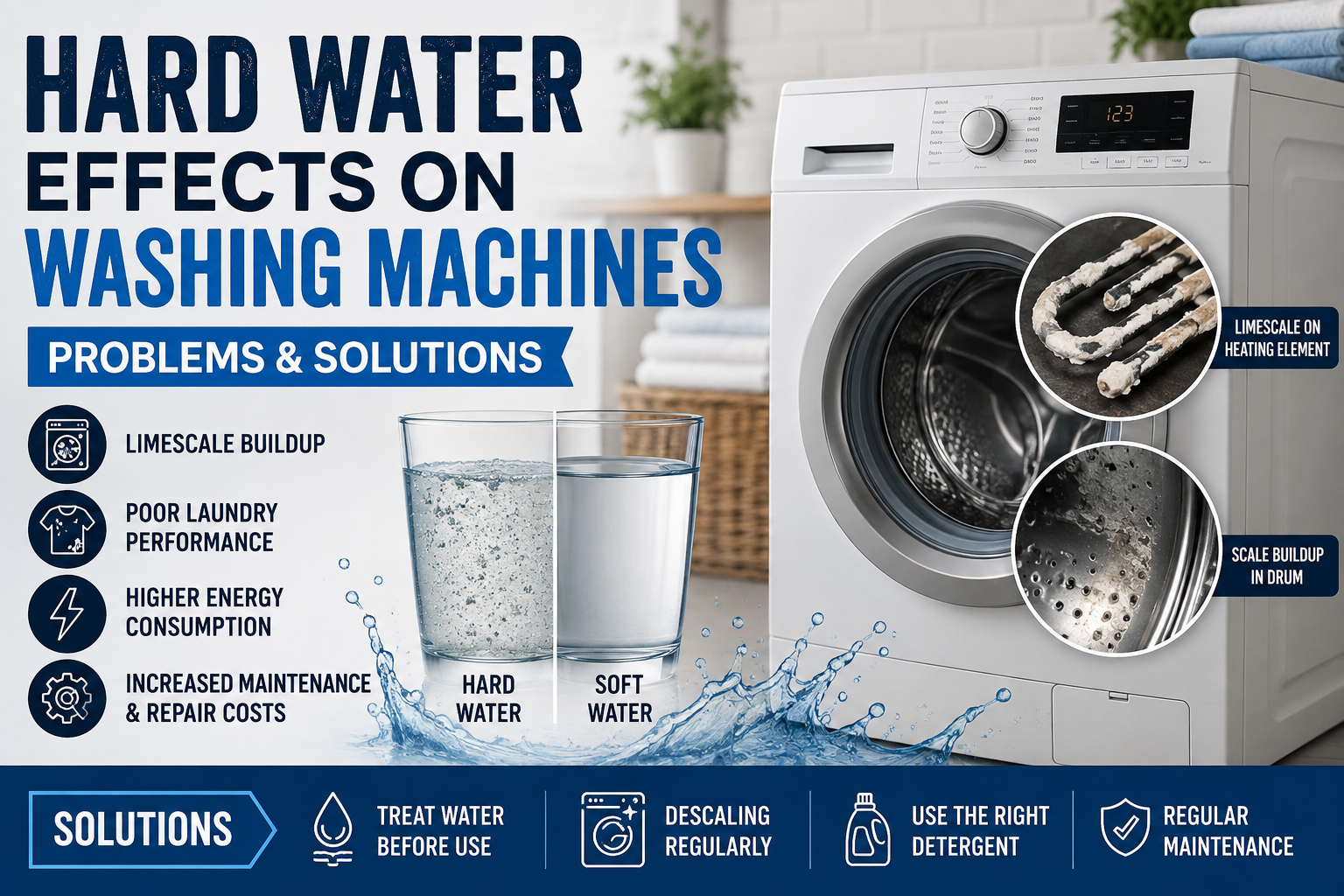
Hard water is a common household concern, especially in areas where groundwater contains high levels of dissolved minerals. Although it may look completely normal, the Hard Water Effects on Washing Machines can gradually impact your washing machine, laundry quality, detergent performance, and maintenance costs.
The Hard Water Effects on Washing Machines are usually not visible immediately. Instead, mineral deposits build up gradually inside components such as the drum, pipes, filters, and heating elements. Over time, this can reduce efficiency and shorten the useful life of the appliance.
Hard water contains a higher concentration of dissolved minerals, primarily calcium and magnesium. When this water is repeatedly used and heated, these minerals can form a chalky deposit known as limescale.
For washing machines, this is particularly important because water passes through the appliance during every wash cycle. Repeated exposure gives mineral deposits more opportunities to accumulate inside the machine.
The Hard Water Effects on Washing Machines can therefore extend beyond simple cleaning problems. They may affect the machine’s internal components, detergent efficiency, energy consumption, and overall maintenance requirements.
One of the main Hard Water Effects on Washing Machines is limescale buildup. Calcium and magnesium deposits can accumulate around the drum, heating element, pipes, filters, and other water-contacting components. This buildup can restrict water flow and reduce the efficiency of some components.
Limescale is one of the most noticeable consequences of hard water. Mineral deposits can gradually form on internal surfaces and heating components.
When the heating element becomes coated with scale, heat transfer can become less efficient. This can make the machine work harder during heated cycles and may contribute to higher energy consumption.
Hard water can interfere with detergent performance. Calcium and magnesium can react with cleaning agents, reducing their effectiveness and contributing to residue.
As a result, you may use more detergent than necessary while still noticing that clothes do not feel as clean as expected.
Another important Hard Water Effects on Washing Machines is its impact on laundry. Mineral and detergent residues can remain on fabric, causing clothes to feel stiff or rough after repeated washing.
White clothes may also appear dull, while coloured fabrics can gradually lose their fresh appearance.
Mineral buildup can reduce the efficiency of heating components. When a machine takes longer or works harder to achieve the required washing conditions, energy consumption can increase. These Hard Water Effects on Washing Machines are one reason why controlling hard water can be useful not only for appliance maintenance but also for improving long-term household efficiency.
The Hard Water Effects on Washing Machines can become more expensive when mineral buildup is allowed to continue unchecked. Blocked filters, restricted water flow, scale-covered components, and reduced performance may result in more frequent cleaning or servicing.
So, how to solve hard water problem in washing machine? The best approach depends on the hardness of your water and the level of mineral buildup already present.
Treating the water before or as it enters your household plumbing can reduce the amount of mineral exposure experienced by appliances. If you are looking for solutions designed to address water-quality concerns, explore KalyxX India’s water treatment products.
For households specifically looking for an appliance-focused solution, you can also explore KalyxX IPS WashBall as part of your hard-water management approach.
Regular descaling can help reduce the Hard Water Effects on Washing Machines by removing accumulated mineral deposits. The appropriate frequency depends on water hardness, washing frequency, machine type, and the manufacturer’s recommendations.
Using a washing-machine-compatible descaling product and following the manufacturer’s instructions is preferable to using unsuitable household chemicals. LG, for example, recommends descaling products specifically designed to remove scale from washing-machine components.
Hard water residue can accumulate around detergent compartments and filters. Cleaning these areas regularly helps prevent buildup from becoming excessive and supports proper water flow and detergent dispensing.
Avoid simply adding large amounts of detergent because the water is hard. Excess detergent can leave additional residue inside the machine and on clothes. Follow the detergent manufacturer’s recommended dosage and consider products appropriate for your water conditions.
For broader water-treatment solutions and expertise, Swiss Aqua is another useful resource for understanding water-quality management.
Does hard water ruin washing machines? Hard water does not necessarily destroy a washing machine immediately, but prolonged exposure can contribute to mineral buildup, reduced efficiency, increased maintenance, and premature wear.
The severity depends on factors such as water hardness, machine design, washing frequency, temperature, maintenance, and whether a suitable water-treatment or descaling strategy is used.
This means you do not necessarily need to replace a washing machine simply because your home has hard water. Preventive maintenance and appropriate water treatment can help manage the problem.
Watch for these common warning signs:
These symptoms do not always prove that hard water is the cause, but they can indicate that the machine needs inspection and cleaning.
Prevention is generally easier and less expensive than dealing with severe mineral buildup. Test your household water if you suspect excessive hardness, follow your washing-machine manufacturer’s maintenance instructions, clean filters and detergent compartments regularly, and schedule descaling when appropriate.
Most importantly, consider a suitable water-treatment solution if your household consistently receives hard water. Managing mineral exposure can help maintain washing performance, protect internal components, and reduce avoidable maintenance costs.
The Hard Water Effects on Washing Machines can develop slowly, but they can influence cleaning performance, detergent efficiency, energy use, and appliance maintenance over time. Limescale buildup is particularly important because it can affect components that come into regular contact with mineral-rich water.
If you live in a hard-water area, don’t wait until your washing machine starts showing serious problems. Regular cleaning, appropriate descaling, correct detergent use, and effective water-treatment solutions can help protect your appliance and maintain better laundry results.
Understanding the Hard Water Effects on Washing Machines and taking preventive action early is one of the simplest ways to support the long-term performance of your washing machine.

Rinu Ann George is an SEO Analyst at Upgraderz,Specializing in Search Engine Optimization,Content Strategy and Digital Visibility.
