Address
64/2357 Kaloor - Kadavanthara Road , Cochin - 682017 , Kerala.

Address
64/2357 Kaloor - Kadavanthara Road , Cochin - 682017 , Kerala.
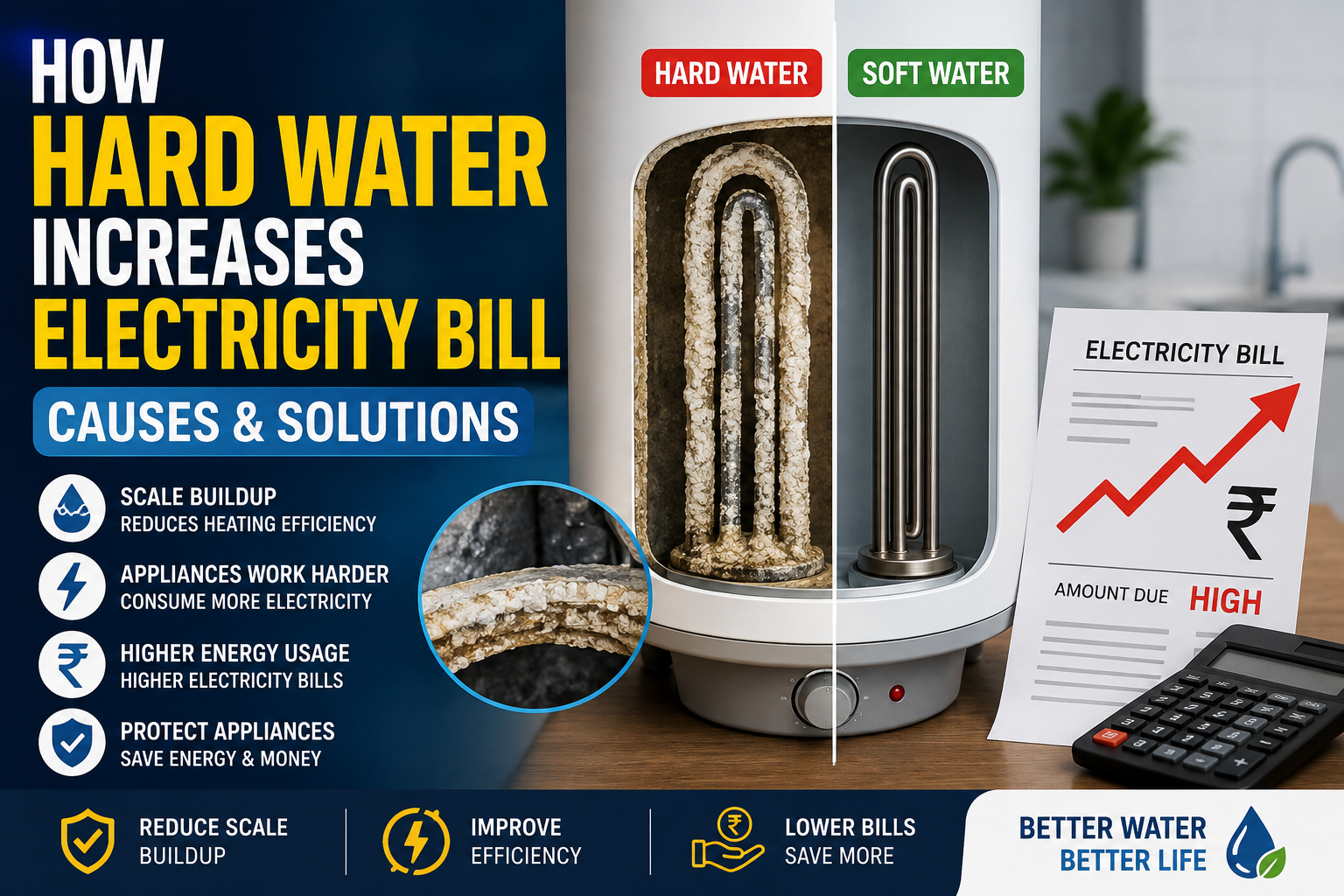
Many homeowners and businesses focus on appliances, electricity tariffs, and daily usage when trying to reduce their power bills. However, water quality can also play an unexpected role in energy consumption. One important factor is hard water, which contains high levels of minerals such as calcium and magnesium. Over time, these minerals can create scale inside water-heating appliances and reduce their efficiency.
Understanding how Hard Water Increases Electricity Bill can help homeowners identify hidden energy losses and take practical steps to improve appliance performance, reduce maintenance requirements, and manage electricity consumption.
Hard water is water that contains elevated concentrations of dissolved minerals, mainly calcium and magnesium. While hard water is generally not considered a direct electrical hazard, it can create problems for appliances that heat or circulate water.
When hard water is repeatedly heated, dissolved minerals can settle on surfaces and form a hard layer known as limescale or mineral scale. This is particularly common in geysers, water heaters, boilers, washing machines, dishwashers, and other water-using appliances.
The energy impact of hard water becomes particularly important in industrial applications. Facilities that operate boilers, chillers, heat exchangers, cooling towers, and large-scale water-heating systems can consume substantial amounts of energy. When mineral scale builds up on heat-transfer surfaces, equipment may require more energy to achieve the same operating performance.
By controlling scale formation, industries can improve heat-transfer efficiency and potentially reduce energy waste. The benefits can extend beyond electricity savings, including lower maintenance requirements, fewer cleaning and repair interruptions, reduced equipment stress, and improved overall system performance.
The relationship between hard water and electricity consumption is particularly noticeable in appliances that frequently heat water.
When mineral deposits accumulate:
Therefore, Hard Water Increases Electricity Bill not because the water itself consumes electricity, but because mineral deposits can reduce the efficiency of appliances that use electricity.
The hard water effects on appliances can extend beyond increased energy consumption. Geysers and water heaters are particularly vulnerable because their heating elements operate at high temperatures.
Washing machines and dishwashers can also be affected by mineral deposits in pipes, heating components, and internal surfaces. Over time, scale buildup can contribute to reduced performance and shorter appliance life.
In water heaters, excessive limescale in water heaters can interfere with efficient heat transfer. The appliance may require more time and energy to heat water, making hard water heating efficiency an important consideration for households with high hot-water usage.
This is another reason why Hard Water Increases Electricity Bill over the long term.
In industrial applications, the effects can be more substantial because boilers, chillers, heat exchangers, cooling systems, and other large-scale equipment may operate continuously. Scale formation on heat-transfer surfaces can reduce efficiency, increase energy requirements, and affect overall system performance. Effective scale management can help industries maintain better operating efficiency and reduce unnecessary equipment stress.
The impact varies depending on several factors, including the hardness level of the water, appliance type, frequency of use, temperature settings, age of the appliance, and amount of scale buildup.
The impact can be more significant in commercial and industrial environments where boilers, chillers, heat exchangers, cooling systems, and other water-dependent equipment operate continuously or at high capacity.
Although hard water is only one factor affecting electricity consumption, ignoring scale buildup for a long period can contribute to unnecessary energy use. Regular appliance maintenance and appropriate water treatment can help maintain efficiency.
In industrial facilities, scale buildup can affect boilers, chillers, heat exchangers, and other critical equipment. Reduced heat-transfer efficiency can increase energy consumption while also contributing to higher maintenance requirements and equipment stress. Managing scale can therefore support potential energy savings, improved equipment performance, and more reliable operations.
A common question is: Can electricity affect the hardness of water
Electricity itself does not normally make water hard or soft. Water hardness is primarily determined by the concentration of dissolved minerals such as calcium and magnesium.
However, electrical water-treatment technologies can be designed to influence how minerals behave in water and reduce the tendency of scale to form on surfaces. These technologies work differently from conventional water softeners, so their operating principles and results should be evaluated according to the specific water conditions and application.
In other words, electricity does not naturally create water hardness. Instead, specialized water-treatment systems may use electrical or electromagnetic principles as part of a strategy for managing scale formation.
If you suspect that hard water is contributing to higher energy consumption, several steps can help.
Start by testing the water hardness level. Knowing the mineral content helps determine whether water treatment is necessary.
Regular inspection and cleaning can help prevent excessive scale buildup. Removing accumulated deposits can improve heating performance.
If a geyser takes noticeably longer to heat water or appliances require longer cycles, scale buildup may be one factor worth investigating.
Appropriate water treatment can help manage hard water and minimize scale-related problems. Explore suitable solutions based on your water quality, appliance requirements, and property needs.
You can learn more about innovative water-treatment solutions through the KalyxX India product range.
Using energy-efficient appliances, maintaining appropriate temperature settings, and avoiding unnecessary hot-water usage can further reduce energy consumption.
These measures can help address the reasons Hard Water Increases Electricity Bill and improve the overall efficiency of water-dependent appliances.
KalyxX India offers innovative water-treatment solutions designed to help manage the challenges associated with hard water and scale formation. Its advanced technologies are developed to support better water-system performance while helping protect appliances and equipment from the effects of mineral buildup.
For homes, commercial buildings, and industrial applications, choosing the right water-treatment technology can make a significant difference in long-term maintenance and operating efficiency. With its focus on modern water-treatment solutions, KalyxX India provides practical options for addressing different water-quality challenges.
Whether you are looking to protect water heaters, reduce scale-related problems, or improve the overall performance of your water system, exploring KalyxX India’s range of innovative water-treatment products can be a valuable step toward more efficient water management.
Explore KalyxX India’s innovative water-treatment solutions through its product range.
Limescale is not simply a cosmetic issue. Persistent mineral deposits can affect heating efficiency, water flow, appliance performance, and maintenance costs.
When heating elements are covered with scale, energy transfer becomes less effective. As a result, the appliance may consume more electricity to perform the same task. Over months and years, this can contribute to higher operating costs.
Therefore, Hard Water Increases Electricity Bill as part of a broader chain: hard water leads to mineral deposits, mineral deposits reduce heat-transfer efficiency, and inefficient appliances may consume more energy.
Managing hard water can be an important part of improving household and commercial water-system efficiency. The right solution depends on the water chemistry, hardness level, application, and type of appliances being used.
For businesses, hotels, food-processing facilities, and large residential properties, controlling scale can also support better equipment performance and potentially reduce maintenance interruptions.
For additional information about modern water-treatment approaches, Swiss Aqua Technologies provides useful resources on water treatment and related technologies.
The connection between water quality and electricity consumption is easy to overlook. Hard water does not directly use more electricity, but mineral scale can reduce the efficiency of appliances that heat water. This is why Hard Water Increases Electricity Bill is an important consideration for homes and businesses that rely heavily on electric water heaters and other water-based appliances.
By testing water hardness, maintaining appliances, monitoring scale buildup, and selecting an appropriate water-treatment solution, property owners can improve appliance performance and potentially reduce unnecessary energy consumption.
Ultimately, Hard Water Increases Electricity Bill through reduced appliance efficiency rather than through the water itself. Understanding this relationship can help you make better decisions about water quality, appliance maintenance, energy efficiency, and long-term operating costs.

Rinu Ann George is an SEO Analyst at Upgraderz,Specializing in Search Engine Optimization,Content Strategy and Digital Visibility.
