Address
64/2357 Kaloor - Kadavanthara Road , Cochin - 682017 , Kerala.

Address
64/2357 Kaloor - Kadavanthara Road , Cochin - 682017 , Kerala.
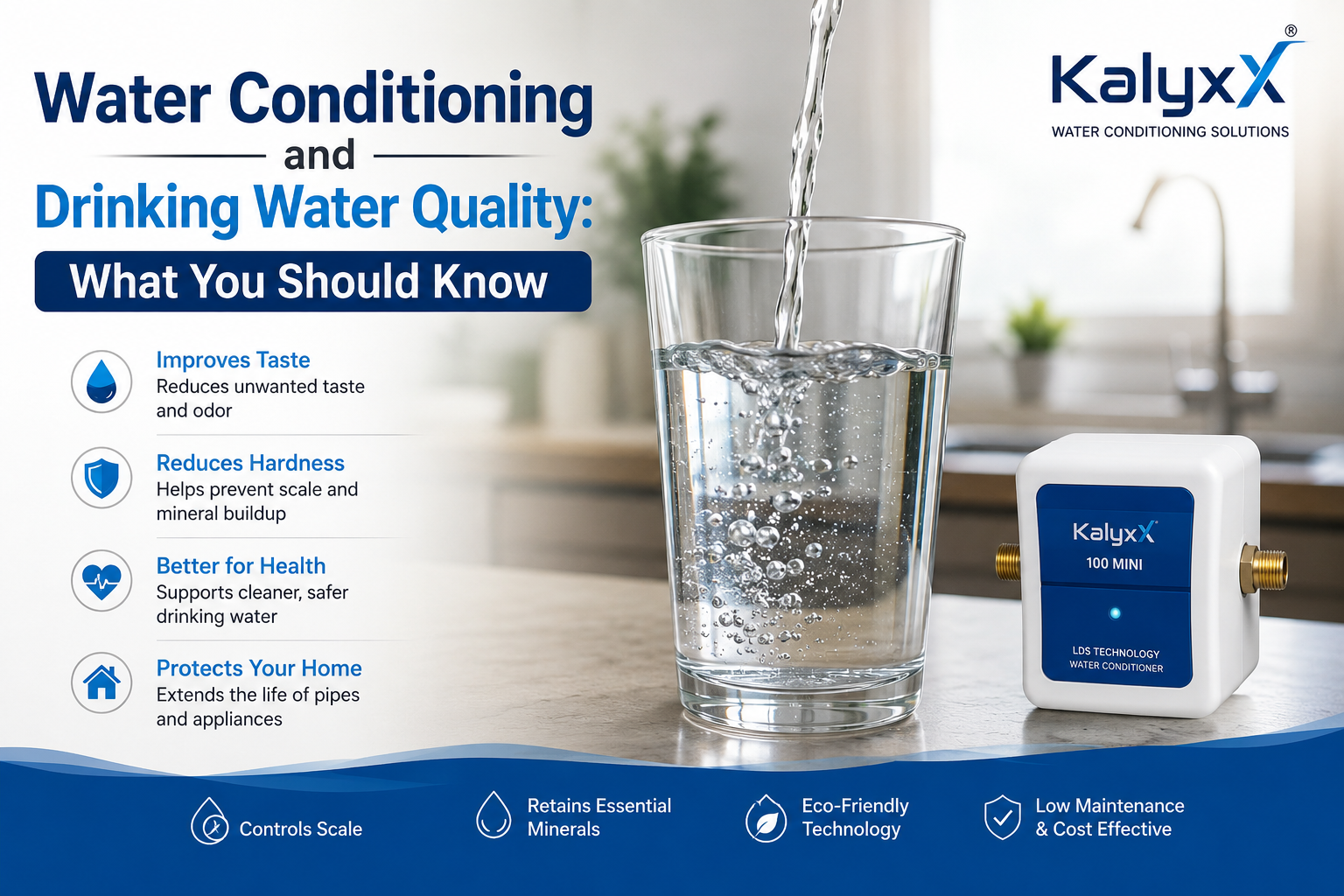
Water quality plays an important role in everyday health, comfort, and household maintenance. While many people associate water treatment with removing harmful contaminants, not every water treatment system performs the same function. Some technologies are designed specifically to address hardness, scale formation, mineral content, taste, or other characteristics of water.
Understanding the relationship between Water Conditioning and Drinking Water Quality can help homeowners choose a treatment solution based on the actual characteristics of their water rather than assuming that one technology can solve every water-quality concern.
Water conditioning is a broad term used for technologies that modify certain characteristics of water to improve its usability or reduce problems associated with minerals and other properties. Depending on the technology, a water conditioner may address scale formation, hardness-related effects, or other water-quality characteristics.
Hard water generally contains higher concentrations of calcium and magnesium. These minerals are not generally considered a health concern at the levels normally found in drinking water, but they can contribute to scale deposits, soap consumption, and household maintenance problems. The World Health Organization notes that water hardness can affect the acceptability of drinking water and has important operational and economic implications.
This is where Water Conditioning and Drinking Water Quality become closely connected. Conditioning can change specific physical or chemical characteristics of water, but the exact effect depends on the treatment technology being used.
Yes, water conditioning can change certain characteristics of drinking water, but the extent and type of change depend entirely on the conditioning method. Understanding Water Conditioning and Drinking Water Quality is important because different treatment systems are designed to address different water-quality concerns.
For example, a conventional water softener using ion exchange reduces calcium and magnesium hardness by exchanging those ions with sodium or potassium ions. This is different from reverse osmosis, activated carbon filtration, ultraviolet treatment, or other purification technologies, each of which is designed for different water-quality objectives.
Therefore, Water Conditioning and Drinking Water Quality should not be treated as exactly the same concept as water purification.
A conditioner may improve the way water behaves without necessarily removing every contaminant that could affect drinking-water safety.
One of the most important things homeowners should understand is the difference between conditioning and purification.
Water conditioning generally focuses on characteristics such as:
Water purification or filtration may target:
The US Environmental Protection Agency explains that drinking-water treatment technologies vary considerably, including activated carbon, ion exchange, reverse osmosis, ultraviolet treatment, and other processes. Each technology has different capabilities and should be selected according to the contaminants or water-quality characteristics that need to be addressed.
As a result, Water Conditioning and Drinking Water Quality should always be evaluated according to the specific water source and the treatment objective.
Hard water primarily contains calcium and magnesium ions. These minerals can create scale on plumbing fixtures, appliances, and heating elements. Hard water can also make it more difficult to produce soap lather.
The presence of calcium and magnesium does not automatically mean that water is unsafe to drink. WHO’s assessment states that hardness at levels normally found in drinking water is not considered a health concern, although it may affect the acceptability of water.
However, homeowners may still prefer to manage hardness because of its effect on household appliances, plumbing, cleaning, and overall water experience.
This is one reason Water Conditioning and Drinking Water Quality is an important consideration for homes using hard groundwater or other mineral-rich water sources.
Not necessarily.
Different water treatment technologies handle minerals in different ways. A traditional ion-exchange softener reduces hardness by exchanging calcium and magnesium ions with sodium or potassium ions. It therefore changes the mineral composition rather than simply removing everything dissolved in the water. Understanding Water Conditioning and Drinking Water Quality helps homeowners recognize that conditioning changes specific water characteristics rather than removing every dissolved substance.
Reverse osmosis, on the other hand, uses a semipermeable membrane and can reduce a much broader range of dissolved substances.
This distinction is important when considering Water Conditioning and Drinking Water Quality because a conditioning device should not automatically be described as a complete drinking-water purification system.
Water taste can be influenced by many factors, including dissolved minerals, chlorine, pH, temperature, and other substances present in the source water.
Reducing excessive hardness or scale-forming characteristics may improve the overall drinking experience for some households. The EPA’s WaterSense guidance notes that softening or conditioning can improve taste and reduce the impacts of water hardness on plumbing systems. This highlights the connection between Water Conditioning and Drinking Water Quality in improving the overall usability of household water.
However, taste improvement does not necessarily mean that all contaminants have been removed. If a household has concerns about a particular contaminant, the treatment technology should be selected specifically for that contaminant.
These terms are often used interchangeably, but they can refer to different technologies.
A water conditioner may be designed to modify the behavior of minerals in water, particularly their tendency to form scale. The exact mechanism depends on the product.
A conventional ion-exchange water softener reduces calcium and magnesium hardness and replaces those ions with sodium or potassium. NSF identifies NSF/ANSI 44 as a standard covering residential cation-exchange water softeners.
A filter can target specific particles, chemicals, taste, odor, or other substances depending on its filtration media and certification.
Reverse osmosis uses pressure to move water through a semipermeable membrane and can reduce a wide range of dissolved contaminants.
Choosing between these technologies requires an understanding of the actual water problem rather than selecting a system solely based on the term “water treatment.”
pH and total dissolved solids (TDS) are two commonly discussed water-quality measurements.
pH indicates whether water is acidic, neutral, or alkaline. TDS represents the total concentration of dissolved substances measured collectively. Neither measurement alone provides a complete assessment of drinking-water safety.
For example, EPA secondary standards identify a pH range of 6.5–8.5 and note that higher TDS can be associated with hardness, deposits, colored water, staining, or salty taste. These are secondary standards intended primarily to address aesthetic or nuisance characteristics rather than directly establish health-based limits.
Therefore, Water Conditioning and Drinking Water Quality should be assessed using more than a single TDS or pH reading.
One of the major reasons homeowners install conditioning systems is to manage the effects of hard water on household infrastructure.
Hardness can contribute to mineral deposits and scale on:
Reducing or controlling scale can help maintain plumbing and appliance performance and may reduce cleaning and maintenance requirements. EPA guidance specifically recognizes scale formation and appliance impacts as reasons households may choose to address hard water.
This means Water Conditioning and Drinking Water Quality can have benefits that extend beyond drinking water itself.
The safety of conditioned water depends on the source water, the conditioning technology, system design, installation, maintenance, and the quality of the incoming water.
A conditioning system should not be assumed to make microbiologically unsafe or contaminated water safe simply because it reduces hardness or scale.
NSF guidance for residential cation-exchange softeners emphasizes that systems covered by NSF/ANSI 44 are intended for drinking water that is already microbiologically safe and of known quality; they are not intended to replace adequate disinfection when water is unsafe.
For this reason, homeowners should test their water when necessary and choose treatment based on identified water-quality requirements.
Before choosing a water conditioner or other treatment system, consider the following:
Start by understanding what is actually present in the water. Testing can provide information about hardness, pH, TDS, iron, microbial quality, and other parameters relevant to your location and water source.
Is your primary concern hard water, scale, taste, odor, iron, microorganisms, or dissolved contaminants?
The answer determines which treatment technology is appropriate.
Always check the manufacturer’s performance claims and technical specifications. A hardness-conditioning device should not automatically be marketed or understood as a complete purifier.
Filters, softeners, membranes, and other systems require appropriate maintenance. A system that is not maintained properly may not perform as intended.
Independent certification can provide additional confidence that a treatment system has been evaluated against an applicable standard. NSF provides consumer guidance on selecting certified water-treatment products and explains the different standards used for different treatment technologies.
For households looking to understand modern approaches to managing hard-water and scale-related problems, exploring different water-conditioning technologies can be useful.
The KalyxX 100 Mini is one option designed for water-conditioning applications. You can learn more about its technology, specifications, and intended application through the KalyxX 100 Mini product page.
You can also explore the broader range of KalyxX water treatment and conditioning products to compare available solutions.
The right solution should always be selected according to the characteristics of the source water and the specific objective of treatment.
There is no single water-treatment technology that is ideal for every household.
Groundwater, municipal water, rainwater, and other sources can have very different mineral and contaminant profiles. Even two homes in the same region can have different water characteristics depending on their source and plumbing.
The EPA notes that selecting a drinking-water treatment approach depends on factors such as source-water chemistry and turbidity, while NSF recommends finding out what is present in the water before selecting a treatment solution.
Consequently, Water Conditioning and Drinking Water Quality should begin with water testing, followed by selecting a treatment method that addresses the identified issue.
Water Conditioning and Drinking Water Quality are connected, but they are not interchangeable concepts. Water conditioning can improve certain characteristics of water, particularly those associated with hardness and scale, while other treatment technologies are designed to address microorganisms, dissolved contaminants, taste, odor, or other concerns.
The best approach is to understand your source water, test it when appropriate, identify the specific problem, and select a treatment technology that is designed for that purpose.
With the right approach, water conditioning can become an important part of a broader household water-management strategy—helping improve water usability, reduce scale-related problems, and support better long-term care of plumbing and appliances.

